FPSC Chemistry Complete Guide for Lecturer – By MK Publications (MK Preparations)
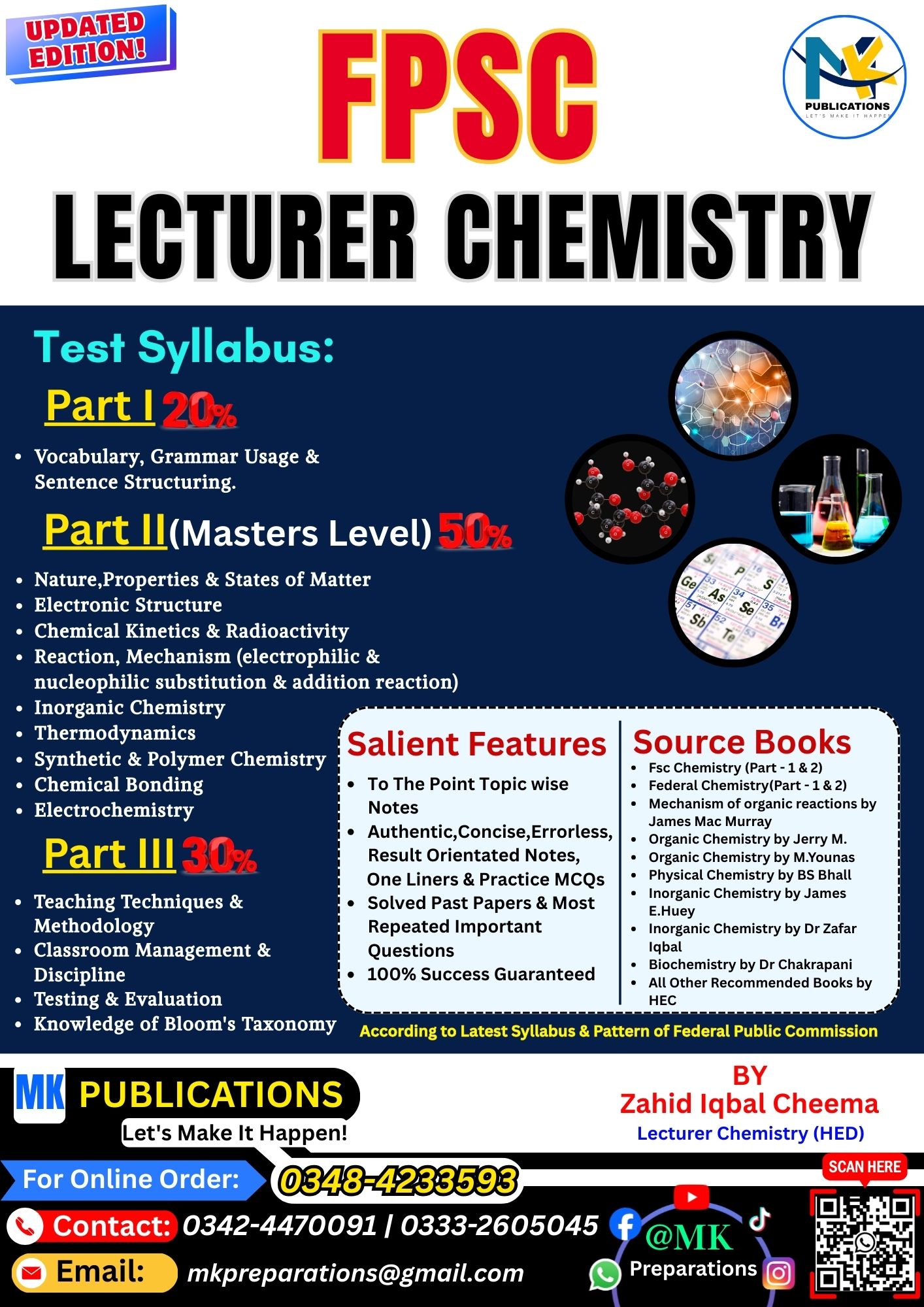
Prepare for success in all FPSC Lecturer and Subject Specialist Competitive Exams with the most comprehensive and exam-oriented FPSC Chemistry Complete Guide by MK Publications. This book is specially designed for aspirants who are preparing for exams conducted by FPSC (Federal Public Service Commission), PPSC, SPSC, BPSC, AJKPSC, KPPSC, NTS, and other testing agencies in Pakistan.
Whether you are applying for FPSC Lecturer (Chemistry), Subject Specialist (Chemistry), SSE (Secondary School Educator) Chemistry, SST (Secondary School Teacher) Chemistry, or any other teaching post requiring Chemistry specialization, this book covers everything you need in one complete volume.
📘 What This Book Contains?
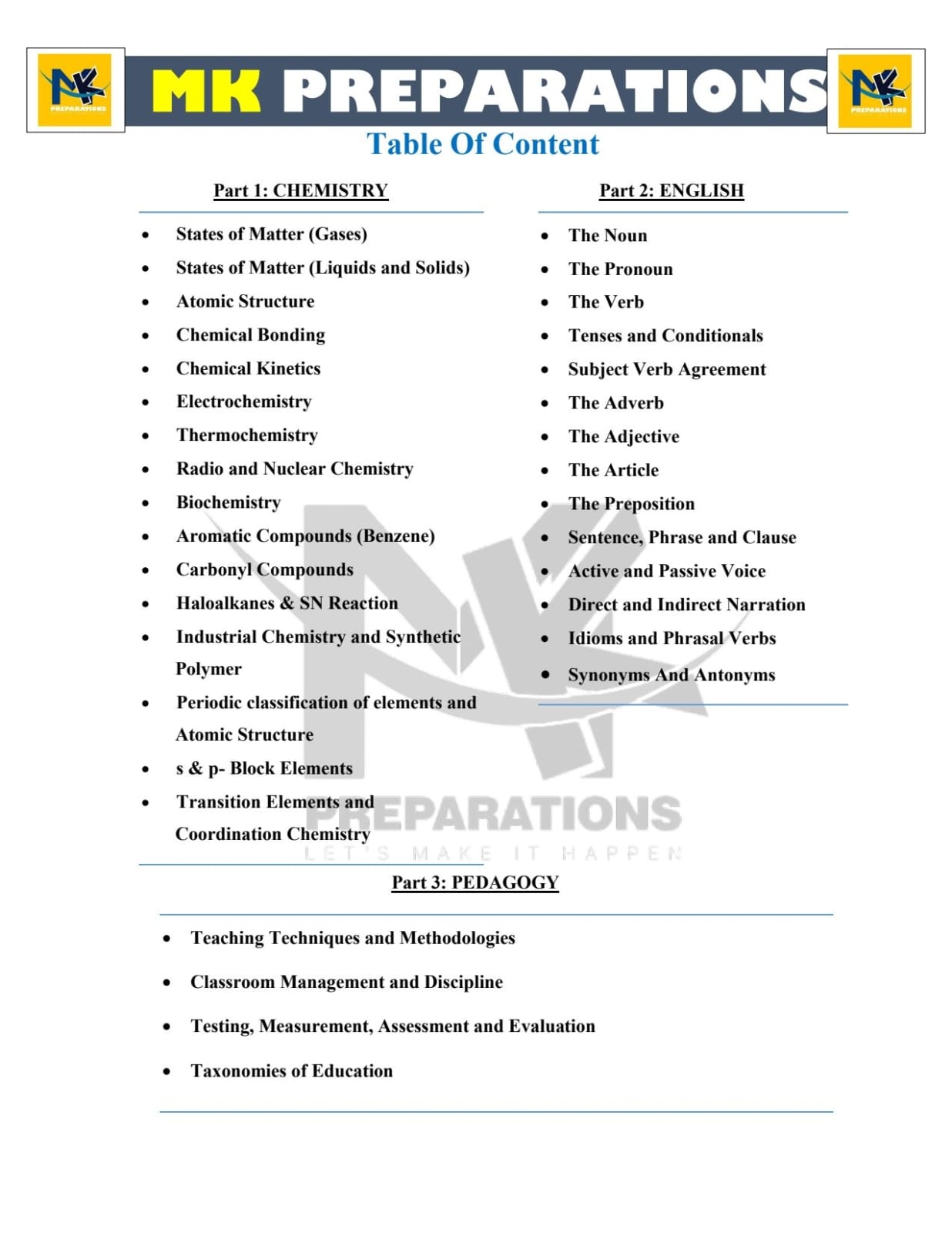
✅ Part 1: CHEMISTRY – Complete Syllabus Coverage
This section covers 16 essential Chemistry topics including:
States of Matter (Gases)
Gas Laws (Boyle’s Law, Charles’s Law, Avogadro’s Law, Ideal Gas Equation), Kinetic Molecular Theory of Gases, Deviation from Ideal Behavior, Van der Waals Equation, Liquefaction of Gases.
States of Matter (Liquids and Solids)
Liquid State: Properties, Vapor Pressure, Surface Tension, Viscosity. Solid State: Types of Solids (Crystalline and Amorphous), Crystal Lattices, Unit Cells, Packing in Crystals, Crystal Defects.
Atomic Structure
Subatomic Particles, Bohr’s Atomic Model, Quantum Mechanical Model, Quantum Numbers, Electronic Configuration, Aufbau Principle, Pauli Exclusion Principle, Hund’s Rule.
Chemical Bonding
Types of Chemical Bonds (Ionic, Covalent, Metallic), Lewis Structures, VSEPR Theory, Molecular Orbital Theory, Hybridization, Bond Parameters (Bond Length, Bond Angle, Bond Energy, Bond Order).
Chemical Kinetics
Rate of Reaction, Factors Affecting Rate, Rate Laws, Order and Molecularity, Integrated Rate Equations, Half-Life, Activation Energy, Arrhenius Equation, Catalysis.
Electrochemistry
Oxidation and Reduction, Electrochemical Cells, Galvanic Cells, Electrode Potential, Nernst Equation, Electrolysis, Faraday’s Laws, Batteries, Fuel Cells, Corrosion.
Thermochemistry
Thermodynamic Terms, First Law of Thermodynamics, Enthalpy, Heat Capacity, Hess’s Law, Enthalpy of Formation, Enthalpy of Combustion, Enthalpy of Neutralization, Bond Enthalpies.
Radio and Nuclear Chemistry
Radioactivity, Types of Radiation, Half-Life, Nuclear Reactions, Fission and Fusion, Nuclear Transmutation, Applications of Radioisotopes, Radiation Hazards.
Biochemistry
Carbohydrates: Classification, Structure, Properties. Proteins: Amino Acids, Peptide Bond, Protein Structure. Lipids: Classification, Properties. Enzymes: Classification, Mechanism of Action. Nucleic Acids: DNA and RNA Structure.
Aromatic Compounds (Benzene)
Structure of Benzene, Aromaticity, Huckel’s Rule, Electrophilic Aromatic Substitution Reactions, Mechanism and Examples, Effects of Substituents.
Carbonyl Compounds
Aldehydes and Ketones: Structure, Nomenclature, Preparation Methods, Physical Properties, Chemical Reactions (Nucleophilic Addition, Oxidation, Reduction), Carboxylic Acids and Their Derivatives.
Haloalkanes & SN Reactions
Alkyl Halides: Classification, Nomenclature, Preparation, Physical Properties. Nucleophilic Substitution Reactions (SN1 and SN2 Mechanisms), Factors Affecting SN Reactions, Elimination Reactions.
Industrial Chemistry and Synthetic Polymer
Chemical Industries, Important Industrial Processes, Polymers: Classification, Types (Addition and Condensation Polymers), Important Synthetic Polymers (Polyethylene, PVC, Polystyrene, Nylon, Polyesters), Applications.
Periodic Classification of Elements and Atomic Structure
Periodic Law, Modern Periodic Table, Periodicity in Properties (Atomic Radius, Ionization Energy, Electron Affinity, Electronegativity), Trends in Periodic Table.
s & p-Block Elements
General Characteristics of s-Block Elements (Group 1 and 2), Compounds, Trends. General Characteristics of p-Block Elements (Groups 13 to 18), Trends, Important Compounds.
Transition Elements and Coordination Chemistry
General Characteristics of Transition Elements, Electronic Configuration, Trends in Properties. Coordination Compounds: Ligands, Coordination Number, Nomenclature, Isomerism, Bonding Theories (VBT, CFT).
✅ Part 2: ENGLISH – Complete Grammar Coverage
This section covers 14 essential English Grammar topics including:
The Noun (Types, Gender, Number, Case), The Pronoun (Types and Usage), The Verb (Types, Forms, Auxiliaries), Tenses and Conditionals (Present, Past, Future, Conditional Sentences), Subject Verb Agreement (Rules with Examples), The Adverb (Types and Placement), The Adjective (Degrees of Comparison, Order), The Article (Definite and Indefinite Usage), The Preposition (Time, Place, Movement, Fixed Prepositions), Sentence, Phrase and Clause (Types and Identification), Active and Passive Voice (Rules and Conversion), Direct and Indirect Narration (Reporting Speech Rules), Idioms and Phrasal Verbs (Most Repeated in Exams), Synonyms and Antonyms (Vocabulary Building).
✅ Part 3: PEDAGOGY – Complete Coverage
This section covers 4 essential Pedagogy topics including:
Teaching Techniques and Methodologies
Teaching Strategies, Instructional Methods, Lecture Method, Discussion Method, Demonstration Method, Activity-Based Learning, Microteaching, Problem-Solving Method.
Classroom Management and Discipline
Behavior Management Techniques, Classroom Environment, Rules and Procedures, Dealing with Disruptive Behavior, Positive Reinforcement, Student Engagement.
Testing, Measurement, Assessment and Evaluation
Types of Tests (Objective, Subjective, Standardized, Teacher-Made), Formative and Summative Assessment, Measurement Scales, Evaluation Techniques, Item Analysis, Reliability and Validity.
Taxonomies of Education
Bloom’s Taxonomy (Cognitive Domain), Affective Domain (Krathwohl’s Taxonomy), Psychomotor Domain (Simpson’s Taxonomy), Educational Objectives and Outcomes, Application in Teaching.
✅ Concept-Based Learning + Practice MCQs
Each topic includes:
-
Detailed Concept Explanation – Clear, easy-to-understand notes
-
Important One-Liners – For quick revision
-
Topic-Wise Practice MCQs – With answers and explanations
-
Most Repeated & Important Questions – Highlighted for focused preparation
This format ensures strong conceptual clarity plus exam-focused preparation.
✅ Best for FPSC Lecturer Chemistry & Related Exams
This book is highly recommended for:
-
FPSC Lecturer (Chemistry)
-
Subject Specialist (Chemistry)
-
SSE (Secondary School Educator) Chemistry
-
SST (Secondary School Teacher) Chemistry
-
All Teaching Posts with Chemistry Specialization
-
PPSC, FPSC, SPSC, BPSC, AJKPSC, KPPSC, NTS Chemistry Exams
-
All Competitive Exams Requiring Chemistry, English, and Pedagogy
🎯 Why Choose MK Publications?
-
Three essential subjects in ONE book – Chemistry, English, and Pedagogy combined
-
Complete syllabus coverage – 16 Chemistry + 14 English + 4 Pedagogy topics
-
To-the-point notes with clear explanations
-
Easy language & exam-oriented content
-
MCQs based on latest syllabus
-
Most repeated questions highlighted
-
Suitable for every MSc/MPhil Chemistry graduate aspirant
-
Prepared by experienced competitive exam mentors
🎥 Extra Support by MK Preparations
Along with the book, students can also get:
-
Recorded Video Lectures
-
Important Books & Notes
-
Online Test Sessions
-
Crash Courses for FPSC Lecturer Exams
Join our new preparation session and increase your chances of selection with proper guidance and smart strategy.
👨🎓 Who Should Buy This Book?
This book is ideal for:
-
MSc / MPhil / PhD in Chemistry graduates
-
FPSC Lecturer Aspirants (Chemistry)
-
Subject Specialist Candidates (Chemistry)
-
Teaching Job Aspirants (Chemistry Specialization)
-
SSE / SST Chemistry Candidates
-
Repeated Exam Candidates
-
Candidates preparing for multiple lecturer exams simultaneously
If you are serious about securing a government lecturer or subject specialist position in Chemistry, this comprehensive FPSC Chemistry Complete Guide will be your ultimate preparation partner.
🔑 Key Words:
FPSC Chemistry Book 2026
Lecturer Chemistry Complete Guide
Subject Specialist Chemistry Notes
FPSC Lecturer Preparation Chemistry
Chemistry English Pedagogy Combined Book
States of Matter Gases Liquids Solids
Atomic Structure Chemical Bonding
Chemical Kinetics Electrochemistry
Thermochemistry Nuclear Chemistry
Biochemistry Aromatic Compounds
Carbonyl Compounds Haloalkanes
Industrial Chemistry Synthetic Polymers
Periodic Table s Block p Block Elements
Transition Elements Coordination Chemistry
English Grammar for FPSC
Tenses Conditionals Subject Verb Agreement
Active Passive Voice Direct Indirect Narration
Idioms Phrasal Verbs Synonyms Antonyms
Pedagogy Teaching Methodologies
Classroom Management Assessment Evaluation
Bloom’s Taxonomy Education
Best Book for Chemistry Lecturer Pakistan
FPSC Lecturer Syllabus 2026
MSc Chemistry Competitive Exam Guide


Reviews
There are no reviews yet.