FPSC English Complete Guide for Lecturer – By MK Publications (MK Preparations)
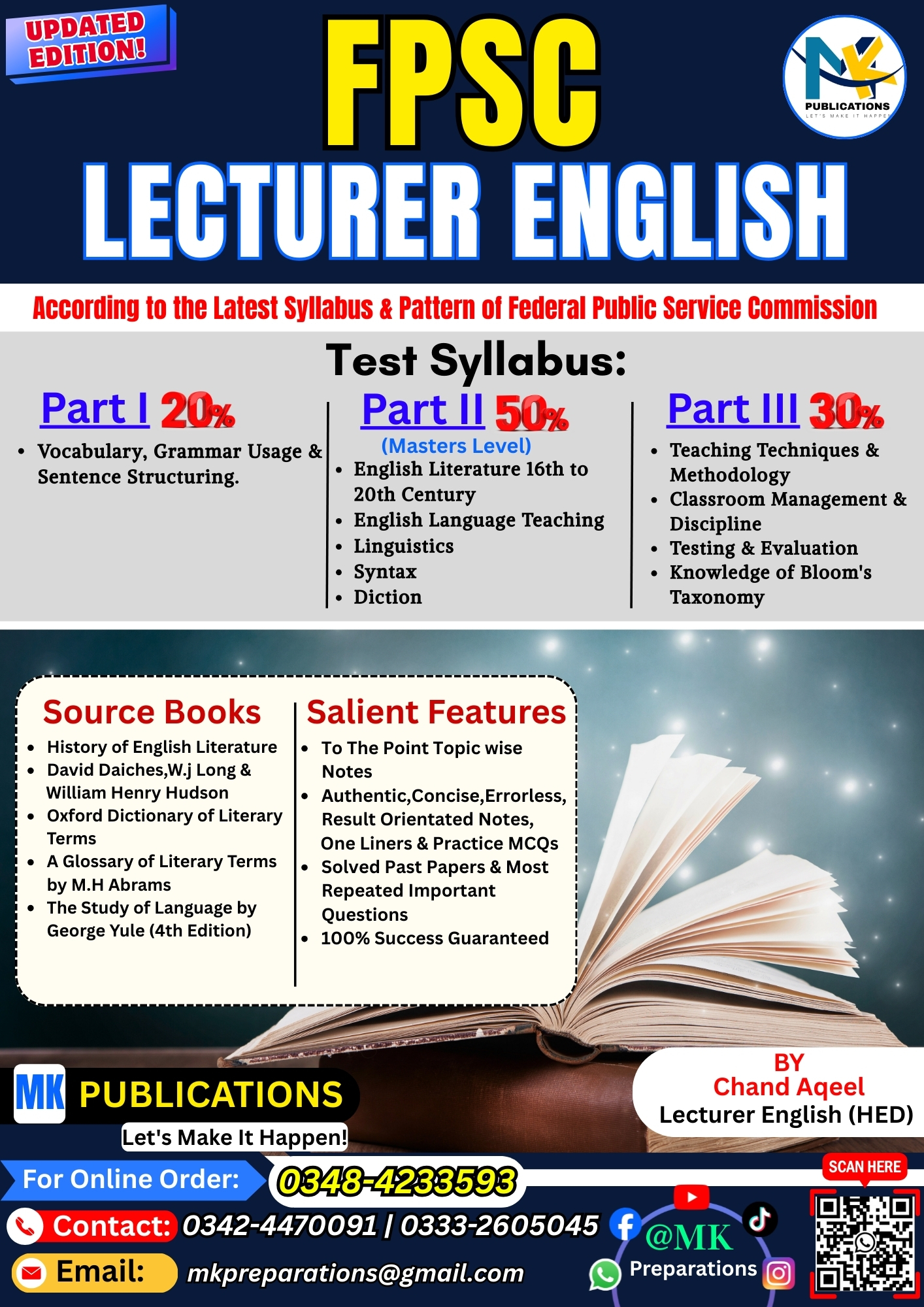
Prepare for success in all FPSC Lecturer and Subject Specialist Competitive Exams with the most comprehensive and exam-oriented FPSC English Complete Guide by MK Publications. This book is specially designed for aspirants who are preparing for exams conducted by FPSC (Federal Public Service Commission), PPSC, SPSC, BPSC, AJKPSC, KPPSC, NTS, and other testing agencies in Pakistan.
Whether you are applying for FPSC Lecturer (English), Subject Specialist (English), SSE (Secondary School Educator) English, SST (Secondary School Teacher) English, or any other teaching post requiring English specialization, this book covers everything you need in one complete volume.
📘 What This Book Contains?
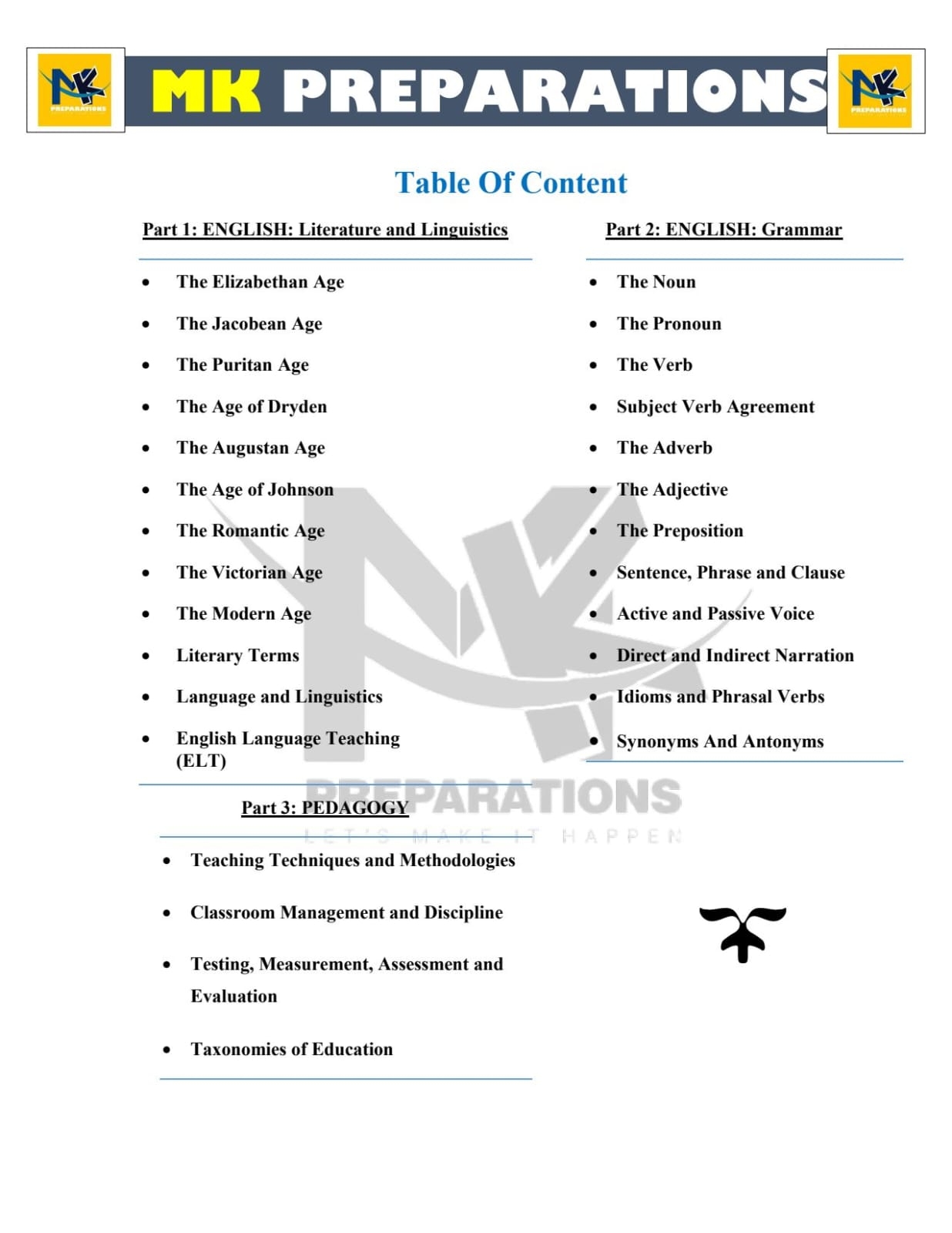
✅ Part 1: ENGLISH LITERATURE AND LINGUISTICS – Complete Syllabus Coverage
This section covers 12 essential English Literature and Linguistics topics including:
The Elizabethan Age
Historical Background, Major Characteristics, Literary Forms (Drama, Poetry, Prose), William Shakespeare (Major Works, Themes, Contributions), Christopher Marlowe, Ben Jonson, Edmund Spenser, Francis Bacon, Major Literary Works and Their Significance.
The Jacobean Age
Historical Background, Characteristics, John Donne and Metaphysical Poetry, Ben Jonson and Cavalier Poets, Francis Bacon’s Essays, King James Bible, Revenge Tragedy, John Webster, Major Literary Works.
The Puritan Age
Historical Background (Civil War, Commonwealth), Puritan Influence on Literature, John Milton (Paradise Lost, Paradise Regained, Samson Agonistes), John Bunyan (The Pilgrim’s Progress), Andrew Marvell, Metaphysical Poets, Major Literary Works.
The Age of Dryden
Historical Background (Restoration), Characteristics of Restoration Literature, John Dryden (Poetry, Drama, Criticism), Restoration Drama (Comedy of Manners), William Congreve, Aphra Behn, Major Literary Works.
The Augustan Age
Historical Background, Neoclassicism, Alexander Pope (Poetry, Satire), Jonathan Swift (Gulliver’s Travels, Satire), Joseph Addison and Richard Steele (Periodical Essays), Daniel Defoe (Robinson Crusoe), Major Literary Works.
The Age of Johnson
Historical Background, Samuel Johnson (Dictionary, Lives of the Poets), James Boswell (Life of Johnson), Oliver Goldsmith (The Vicar of Wakefield, She Stoops to Conquer), Thomas Gray (Elegy Written in a Country Churchyard), Edward Gibbon, Rise of the Novel, Major Literary Works.
The Romantic Age
Historical Background (French Revolution, Industrial Revolution), Characteristics of Romanticism, William Wordsworth (Preface to Lyrical Ballads, Major Poems), Samuel Taylor Coleridge (The Rime of the Ancient Mariner, Kubla Khan), John Keats (Odes), Percy Bysshe Shelley (Prometheus Unbound), Lord Byron (Don Juan), William Blake, Mary Shelley (Frankenstein), Jane Austen (Novels), Major Literary Works.
The Victorian Age
Historical Background (Industrialization, Empire), Characteristics of Victorian Literature, Alfred Lord Tennyson (Poetry), Robert Browning, Elizabeth Barrett Browning, Matthew Arnold, Charles Dickens (Novels, Social Criticism), William Makepeace Thackeray, George Eliot, Thomas Hardy, Bronte Sisters (Charlotte, Emily, Anne), Oscar Wilde, Major Literary Works.
The Modern Age
Historical Background (World Wars, Technological Change), Characteristics of Modernism, T.S. Eliot (The Waste Land, Poetry), James Joyce (Ulysses, Portrait of the Artist), Virginia Woolf (Mrs. Dalloway, To the Lighthouse), D.H. Lawrence, W.B. Yeats (Poetry), Joseph Conrad, E.M. Forster, George Orwell, Samuel Beckett, Major Literary Works.
Literary Terms
Comprehensive List of Literary Terms with Examples: Allegory, Alliteration, Allusion, Antagonist, Apostrophe, Archetype, Assonance, Ballad, Blank Verse, Caesura, Characterization, Climax, Comedy, Conflict, Connotation, Couplet, Denotation, Denouement, Diction, Dramatic Monologue, Elegy, Epic, Epigram, Epithet, Essay, Fable, Farce, Figure of Speech, Flashback, Foreshadowing, Genre, Haiku, Hubris, Hyperbole, Imagery, Irony, Metaphor, Metonymy, Meter, Myth, Narrator, Novel, Ode, Onomatopoeia, Paradox, Parody, Personification, Plot, Point of View, Protagonist, Quatrain, Realism, Refrain, Rhyme, Rhythm, Satire, Simile, Soliloquy, Sonnet, Stream of Consciousness, Style, Symbolism, Synecdoche, Theme, Tone, Tragedy, Understatement, Verse.
Language and Linguistics
Phonetics (Articulatory, Acoustic, Auditory), Phonology (Phonemes, Allophones), Morphology (Morphemes, Word Formation), Syntax (Phrase Structure, Grammar), Semantics (Meaning, Sense Relations), Pragmatics (Speech Acts, Context), Sociolinguistics (Language Variation, Dialects), Historical Linguistics (Language Change), Psycholinguistics (Language Acquisition), Applied Linguistics.
English Language Teaching (ELT)
Approaches and Methods in Language Teaching (Grammar-Translation, Direct Method, Audio-Lingual, Communicative Language Teaching), Techniques and Strategies, Lesson Planning, Materials Development, Language Skills (Listening, Speaking, Reading, Writing), Error Analysis, Syllabus Design, Curriculum Development, Testing and Evaluation in ELT.
✅ Part 2: ENGLISH GRAMMAR – Complete Coverage
This section covers 12 essential English Grammar topics including:
The Noun – Types (Proper, Common, Collective, Abstract, Material), Gender, Number, Case, Noun Functions in Sentences.
The Pronoun – Types (Personal, Possessive, Reflexive, Demonstrative, Interrogative, Relative, Indefinite), Pronoun-Antecedent Agreement, Usage Rules.
The Verb – Types (Action, Linking, Helping), Regular and Irregular Verbs, Verb Forms (Base, Past, Past Participle), Transitive and Intransitive Verbs, Auxiliaries (Primary and Modal).
Subject Verb Agreement – Basic Rules, Singular and Plural Subjects, Compound Subjects, Indefinite Pronouns, Collective Nouns, Special Cases, Distances and Measurements.
The Adverb – Types (Manner, Place, Time, Frequency, Degree, Interrogative, Relative), Formation of Adverbs, Comparison, Placement in Sentences.
The Adjective – Types (Descriptive, Proper, Quantitative, Numeral, Demonstrative, Interrogative, Possessive), Degrees of Comparison, Order of Adjectives.
The Preposition – Types (Time, Place, Direction, Agent, Manner), Prepositional Phrases, Fixed Prepositions, Common Errors, Prepositions with Verbs and Adjectives.
Sentence, Phrase and Clause – Sentence Types (Simple, Compound, Complex, Compound-Complex), Phrase Types (Noun, Verb, Adjective, Adverb, Prepositional), Clause Types (Independent, Dependent, Noun, Adjective, Adverb).
Active and Passive Voice – Rules for Conversion, Tenses in Active and Passive Voice, Verbs with Two Objects, Imperative Sentences, Interrogative Sentences, Sentences with Modals.
Direct and Indirect Narration – Rules for Changing Speech, Reporting Verbs, Changes in Tenses, Changes in Pronouns, Changes in Time and Place Words, Exclamatory and Imperative Sentences, Questions in Indirect Speech.
Idioms and Phrasal Verbs – Most Repeated Idioms in Exams, Common Phrasal Verbs, Meanings and Usage, Example Sentences, Contextual Application.
Synonyms and Antonyms – Vocabulary Building, Word Meanings, Opposite Words, Most Repeated in Competitive Exams, Contextual Usage.
✅ Part 3: PEDAGOGY – Complete Coverage
This section covers 4 essential Pedagogy topics including:
Teaching Techniques and Methodologies
Teaching Strategies, Instructional Methods, Lecture Method, Discussion Method, Demonstration Method, Activity-Based Learning, Microteaching, Problem-Solving Method, Cooperative Learning, Inquiry-Based Learning, Flipped Classroom.
Classroom Management and Discipline
Behavior Management Techniques, Classroom Environment, Rules and Procedures, Dealing with Disruptive Behavior, Positive Reinforcement, Student Engagement, Motivation Techniques, Time Management, Teacher-Student Relationships.
Testing, Measurement, Assessment and Evaluation
Types of Tests (Objective, Subjective, Standardized, Teacher-Made, Diagnostic, Formative, Summative), Measurement Scales, Evaluation Techniques, Item Analysis, Reliability and Validity, Rubrics, Grading Systems, Feedback Mechanisms.
Taxonomies of Education
Bloom’s Taxonomy (Cognitive Domain: Knowledge, Comprehension, Application, Analysis, Synthesis, Evaluation), Affective Domain (Krathwohl’s Taxonomy: Receiving, Responding, Valuing, Organization, Characterization), Psychomotor Domain (Simpson’s Taxonomy: Perception, Set, Guided Response, Mechanism, Complex Overt Response, Adaptation, Origination), Educational Objectives and Outcomes, Application in Teaching, Writing Learning Objectives.
✅ Concept-Based Learning + Practice MCQs
Each topic includes:
-
Detailed Concept Explanation – Clear, easy-to-understand notes
-
Important One-Liners – For quick revision
-
Topic-Wise Practice MCQs – With answers and explanations
-
Most Repeated & Important Questions – Highlighted for focused preparation
This format ensures strong conceptual clarity plus exam-focused preparation.
✅ Best for FPSC Lecturer English & Related Exams
This book is highly recommended for:
-
FPSC Lecturer (English)
-
Subject Specialist (English)
-
SSE (Secondary School Educator) English
-
SST (Secondary School Teacher) English
-
All Teaching Posts with English Specialization
-
PPSC, FPSC, SPSC, BPSC, AJKPSC, KPPSC, NTS English Exams
-
All Competitive Exams Requiring English Literature, Linguistics, Grammar, and Pedagogy
🎯 Why Choose MK Publications?
-
Four essential areas in ONE book – English Literature, Linguistics, Grammar, and Pedagogy combined
-
Complete syllabus coverage – 12 Literature + 12 Grammar + 4 Pedagogy topics
-
To-the-point notes with clear explanations
-
Easy language & exam-oriented content
-
MCQs based on latest syllabus
-
Most repeated questions highlighted
-
Suitable for every MA/MPhil English graduate aspirant
-
Prepared by experienced competitive exam mentors
🎥 Extra Support by MK Preparations
Along with the book, students can also get:
-
Recorded Video Lectures
-
Important Books & Notes
-
Online Test Sessions
-
Crash Courses for FPSC Lecturer Exams
Join our new preparation session and increase your chances of selection with proper guidance and smart strategy.
👨🎓 Who Should Buy This Book?
This book is ideal for:
-
MA / MPhil / PhD in English Literature or Linguistics graduates
-
FPSC Lecturer Aspirants (English)
-
Subject Specialist Candidates (English)
-
Teaching Job Aspirants (English Specialization)
-
SSE / SST English Candidates
-
Repeated Exam Candidates
-
Candidates preparing for multiple lecturer exams simultaneously
If you are serious about securing a government lecturer or subject specialist position in English, this comprehensive FPSC English Complete Guide will be your ultimate preparation partner.
🔑 Key Words:
FPSC English Book 2026
Lecturer English Complete Guide
Subject Specialist English Notes
FPSC Lecturer Preparation English
English Literature Linguistics Grammar Pedagogy Combined Book
Elizabethan Age Shakespeare
Jacobean Age Metaphysical Poets
Puritan Age Milton Paradise Lost
Age of Dryden Restoration Literature
Augustan Age Pope Swift
Age of Johnson Dr Johnson
Romantic Age Wordsworth Coleridge Keats Shelley
Victorian Age Dickens Tennyson
Modern Age Eliot Joyce Woolf
Literary Terms Complete List
Language and Linguistics Phonetics Morphology Syntax
English Language Teaching ELT Methods
English Grammar Noun Pronoun Verb
Subject Verb Agreement Tenses
Active Passive Voice Direct Indirect Narration
Idioms Phrasal Verbs Synonyms Antonyms
Pedagogy Teaching Methodologies
Classroom Management Assessment Evaluation
Bloom’s Taxonomy Education
Best Book for English Lecturer Pakistan
FPSC Lecturer Syllabus 2026
MA English Competitive Exam Guide


Reviews
There are no reviews yet.